Thursday, July 15, 2010

Covert Affairs Pilot

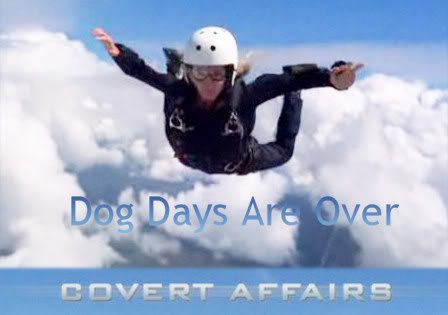
I liked the pilot of USA's new show, Covert Affairs.


The song that played at the beginning was Dog Days Are Over, by Florence and the Machine.
YouTube
ilike

Read some online talk about the show being like Alias, but I never watched Alias, so don't have an opinion about that.

There was a thunderstorm, so satellite went out at that critical moment at the end of the show when Joan and Arthur have the conversation about the Annie's ex-boyfriend. Sheesh.

So I watched it online.
It re-airs on TV Saturday morning, so I may record it again too.
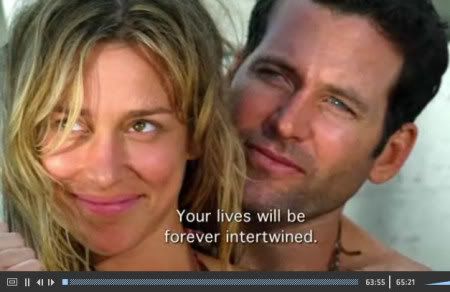


The ex-boyfriend mystery (Eion Bailey [b. 8 Jun 76] as Ben Mercer) was the most interesting part of the show for me.
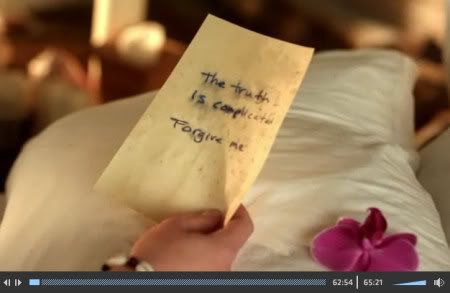


All the crime solving action stuff bored me. I'm tired of crime shows. I'm not sure I'll continue to like and watch Covert Affairs.

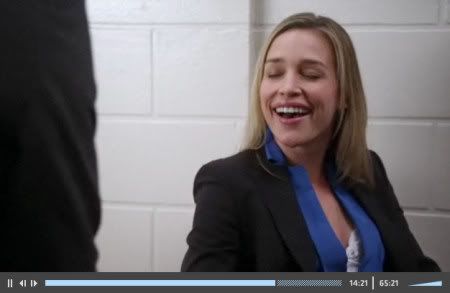
I do like Piper Perabo (b. 31 Oct 76) as Annie Walker. I loved her laugh when she was being questioned.


The song that played at the end was Before It Breaks, by Brandi Carlile.
YouTube (Artist performs.)
YouTube2 (Better sound.)
ilike


I thought TNT's new show, Rizzoli & Isles, was a dud, though. I like Sasha Alexander, (b. 17 May 73) who plays the medical examiner, Maura Isles.

Saturday, July 10, 2010

Photo Drive

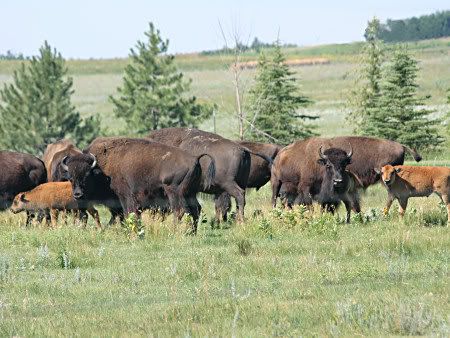
I was taking a picture of a black metal buffalo sign, when...
wait...
there's a real buffalo in the background!
LOL

Anyway, discovered someone is raising a herd of buffaloes around here.


American bison (Bison bison)
enature
wiki

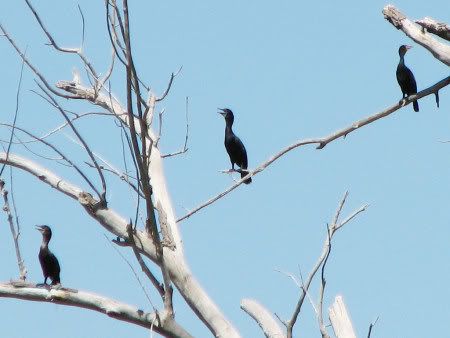
Cormorant

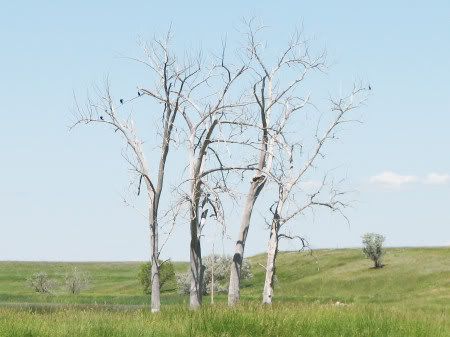
Several scenes near water like this:

Couldn't get closer than that.

Double-crested Cormorant (Phalacrocorax auritus)
enature
cornell

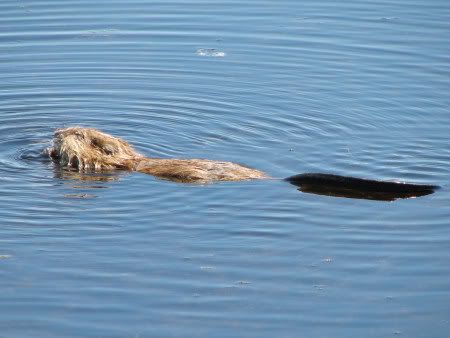
And what do we have here:

Common Muskrat (Ondatra zibethicus)
enature

I thought it was just some debris in the water at first.
The tail is like a rat, not flat like a beaver.
Muskrats are smaller than beavers.
Also the area, just a roadside water hole or creek.
Plus the time of day, late morning.
It all just added up to muskrat, not beaver.

Thursday, July 08, 2010

Characters

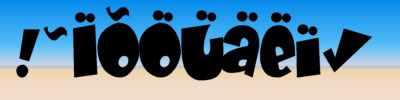
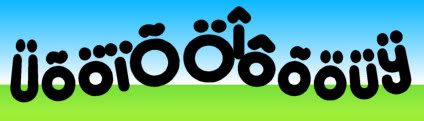
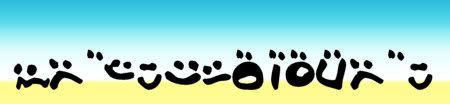
I was using Windows Character Map and it dawned on me that I don't think of the extended characters. There are dingbats that I didn't know I had. Anyway, I discovered that foreign letters can look like silly smileys in some font types.

Baby Kruffy Font:


(Exclamation and checkmark are there just cuz I liked them. The tilde looks like a bird.)

Alba Matter Font:


Croobie Font:


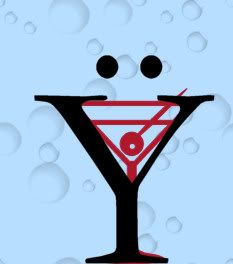
Martini Guy:

The foreign Y is Garmond font.
The red martini glass is Webding font.

Here's a pretty pattern I made from WPMathExtendedA font symbols.


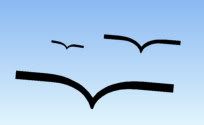
And some birds, same font.


So that was a fun distraction for a while.

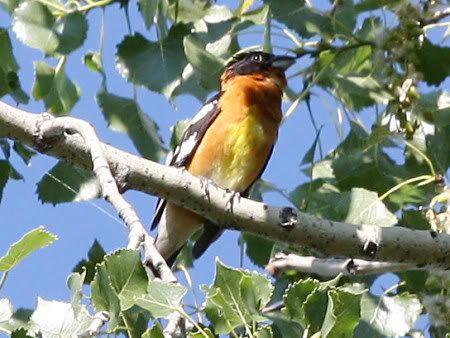
Black-headed Grosbeak


Better head detail than previous post.

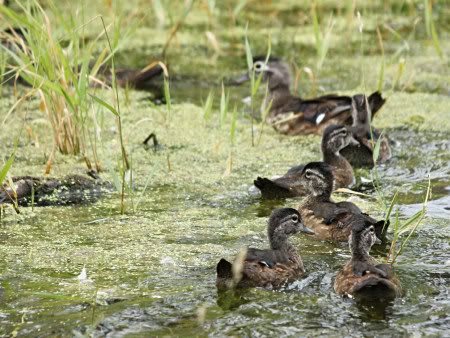
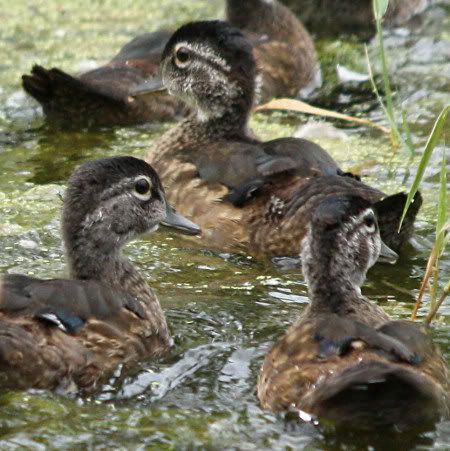
The Wood Duck Family


There were so many babies, I couldn't count them all and they disappeared quickly.


Site: water in ditch alongside road.

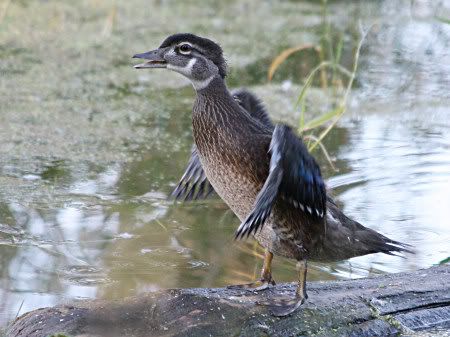
Same spot, next day:


Busy scratching and fluffing feathers.

At first, I thought this was an adult female because of the size, however, looking at the face markings, I think this might be an immature wood duck. The mature female wood duck has a distinct white color around the eye that is different from younger wood ducks.

See previous blog post on wood duck with male and female together.

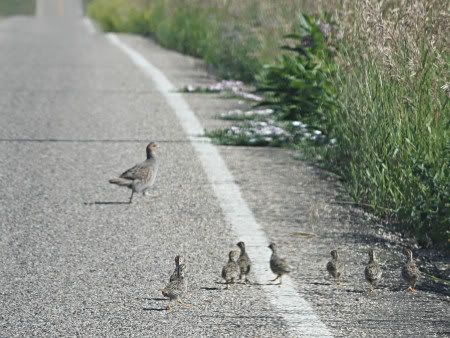
The Partridge Family

So we're driving down the road, slowing down, looking for a hawk that's been hanging around near our place and...
Surprise!


The partridge family pops up on the road!
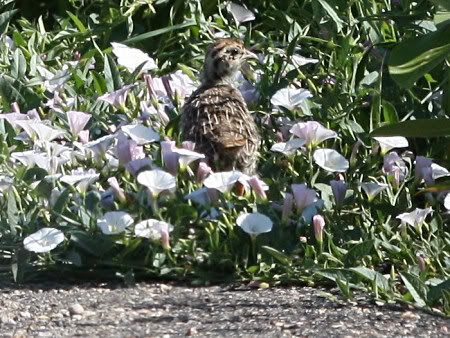
Gray Partridge (Perdix perdix )
I think that's what we saw. The pics weren't that clear.
I barely had time to take a few pics thru the windshield before they disappeared into the ditch.
I counted eight in her brood.

One baby got a little confused by all the excitement and lingered a tad longer alongside the road.


cornell
"Gray Partridge hens produce some of the largest clutches of any bird species. Clutch size can range up to 22 eggs, and averages 16 to 18."

enature

npwrc
Family Phasianidae (same family as ring-necked pheasant)

(NOTE: ENature says grouse too, but npwrc has grouse under a different family, Tetraonidae. I'm assuming ENature and Cornell are probably more up-to-date than npwrc.)

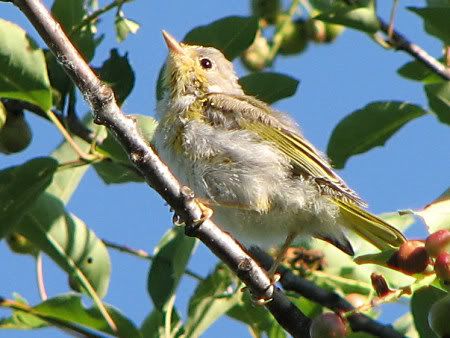
Baby Yellow Warbler


Not sure at what point birds are called a juvenile, but he could fly.
(nestling, fledgling, juvenile, immature, young, etc. )

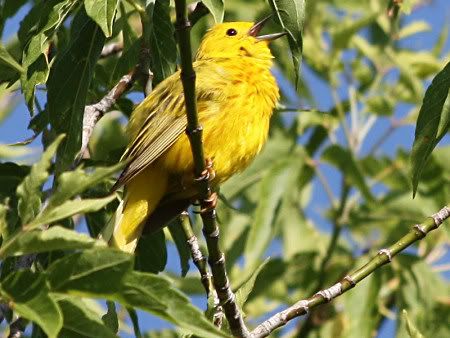
Hey, this could be papa, a little further down the trail.

Do the males/fathers stick around at this stage, I don't know.
The mama was right there by baby, of course, just didn't get a pic of her.

enature
cornell

cornell glossary
Nestling - A young bird after hatching and before leaving the nest.
Fledgling - A young bird that left its nest but is not yet able to survive on its own.
Juvenile - A young bird, typically one that is recently fledged and has not attained its full adult plumage.

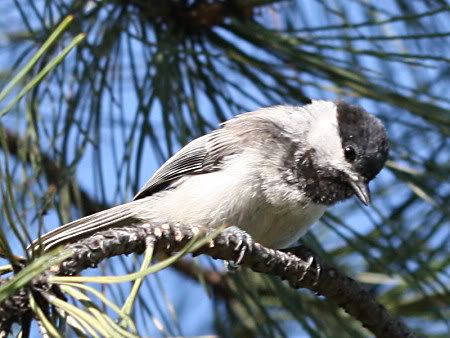
Black-capped Chickadee

Black-capped Chickadee (Poecile atricapillus)


I think chickadees are supposed to have some yellow on the side belly. Can't see any hint of yellow. That part might be a bit over-exposed.

I have wanted a chickadee photo ever so much for a long time, but have never been able to get close enough to them. I can hear them all the time. I love the chickadee's little polite two-note song. They are usually too far away, high up in the tree, and/or they are so tiny I usually can't see them.
My companion went chasing after the chickadee with the tele and got a picture! I was so excited. Except, I didn't get to take it.

Chickadees don't migrate. How they survive the brutal cold is interesting.

Chickadees Are Cold Weather Machines

Google heterothermy

How Wild Birds Stay Warm in the Winter
"Thermogenesis is a fancy name for shivering. You can't really see it, but all birds shiver in the cold of winter."
"At night, birds such as the little chickadee take shivering, or lack of one step further. To conserve heat and energy, chickadees can lower their body temperature by interrupting their shivering. These periods of inactivity allow the bird's body temperature to slowly cool, until it drops about 10 or 12 degrees. At this point, the bird enters a state of unconsciousness called torpor. Respiration and heart rate will also drop during this period."

cornell
"In most of North America, the song is a simple, pure 2 or 3-note whistled fee-bee or hey, sweetie."

enature
"a clear, whistled fee-bee, the second note lower and often doubled."

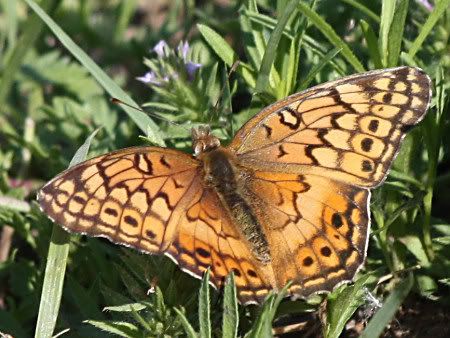
Variegated Fritillary Butterfly

Variegated Fritillary (Euptoieta claudia)


bugguide
butterfliesandmoths
enature
Butterflies of North Dakota

Monday, July 05, 2010

Firefox Personas

I was checking out the Firefox Personas.
Most of them compete with the browser UI too much and look awful on my screen.
I use a Bookmarks Toolbar and I need to be able to read that text.

I can preview, but can't use my own created images, unless I submit them to the public online gallery.
(Discussion of that here, here, and here.
This is supposed to be fixed with Firefox 3.6.7 version update.

I'll probably use Personas when the bug is fixed and I can just use my own without making them public.
It's much simpler to create them for my monitor and UI only.
My monitor is 1024x768, 17 inch.
The image sizes required for public use are much larger than what I need and only a small portion of the image is actually displayed on my screen.

How to Create Your Own Persona
"subtle, soft contrast images and gradients work best"

"highly detailed images will compete with the browser UI"

I think most people are ignoring that advice, LOL.

A person could use almost any image as long as the colors were faded with a white overlay layer on top at about 50% percent opacity.

File size limit is 300KB.
PNG or JPG file format.

Headers:
Header image size: 3000x200.
Header image displays from top right to left.
I only see the top right 1024x70 (Tabs) or 1024x94 of a 3000x200 image.
If I could make headers for my use only, I could just make them 1024x100.

Footers:
Footer image size: 3000x100.
Footer image displays from bottom left to right.
I only see the left bottom 1024x22 of a 3000x100 image.
When I used Edit, Find in Firefox my footer becomes about 50 pixels high.
So I'd need to make my footer about 1024x50.

I found one persona in the public gallery I really like and that's Nice Flower.
(Again, I only see the top right portion.)
Instead of using the plain green footer, I'd crop that "nice flower" header image and make a footer out of it.

Saturday, July 03, 2010

Music

I really like OneRepublic.

I've posted Marching On a few weeks ago.

Three more songs:
Good Life
Made For You
Secrets

New (to me) Artists:

Alpha Rev:
wiki
myspace

Songs:
New Morning
Phoenix Burn

The Honorary Title:
wiki
myspace

Songs:
Stay Away
Petals
Frame by Frame

UPDATE 25Aug11:
Changed/updated dead links so all work now.

Friday, July 02, 2010

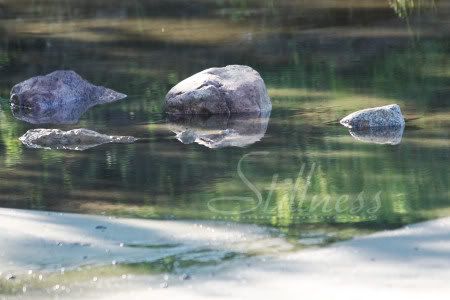
Stillness


When scanning the river bank with my tele, I get these dreamy photos.

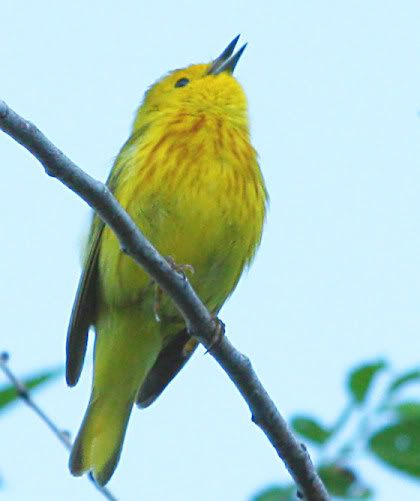
Yellow Warbler - Male

Yellow Warbler - Male:


The male is bright orange-yellow.

The female is a duller green-yellow.

Sunday, June 27, 2010

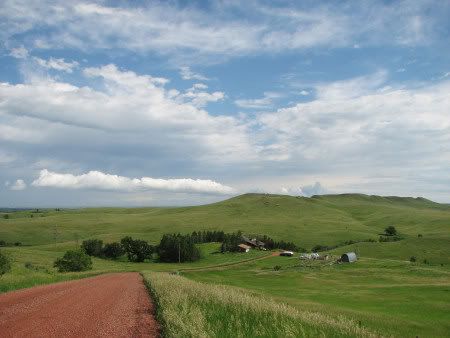
Scenery

A few scenery pics that I liked from the photo drive.


I call them "grand sky" pics.
Fabulous ever changing cloud patterns that day.
Lots of rain, everything is lush green.
The gravel road really is that pretty reddish color. Scoria? It had just rained, so not dusty.

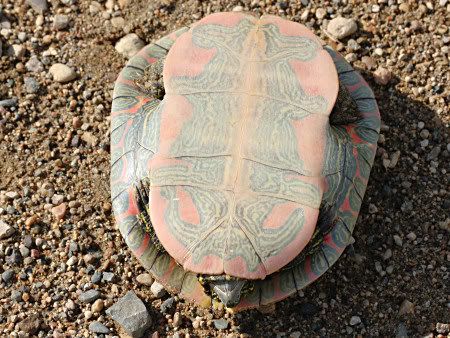
Belly Up

Photo Drive.
Blogged painted turtle previously.

This time I got a belly shot.
(plastron)


This little guy was sunning himself on the gravel road.
So took pics, turned him over for the belly shot, and moved him out of the way of traffic.
His coloring was faded, not dusty.

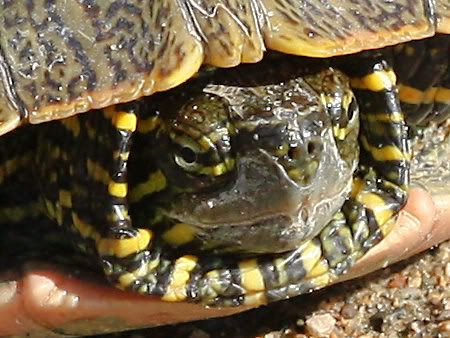
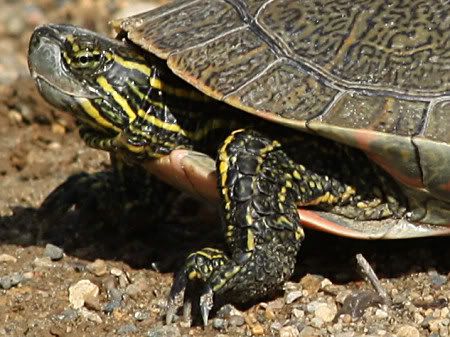
Here's some closeup detail:

Mugshot:

Look at those claws:

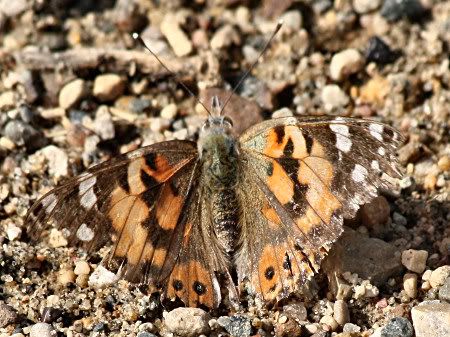
Painted Lady Butterfly

Photo Drive.
Painted Lady (Vanessa cardui)


Same Genus as Red Admiral.

bugguide
Genus Vanessa - Ladies and Red Admiral
Species cardui - Painted Lady

butterfliesandmoths
enature
"...the Painted Lady is perhaps the most widespread butterfly in the world, found throughout Africa, Europe, Asia and many islands, as well as in North America."

Butterflies of ND

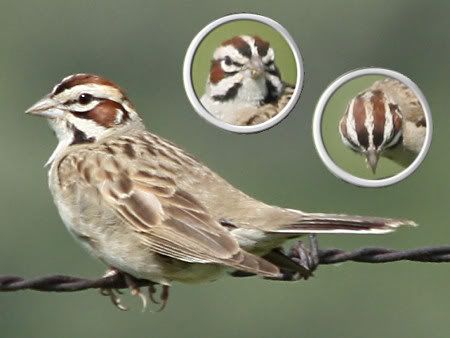
Lark Sparrow

Photo Drive.


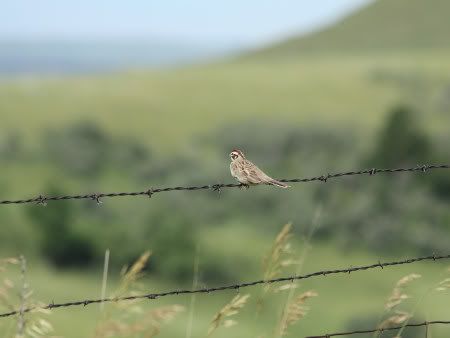
My first Lark Sparrow (Chondestes grammacus).
I knew this one would be easy to identify. He's interesting to look at from different angles. Makes me think of candy cane stripes.

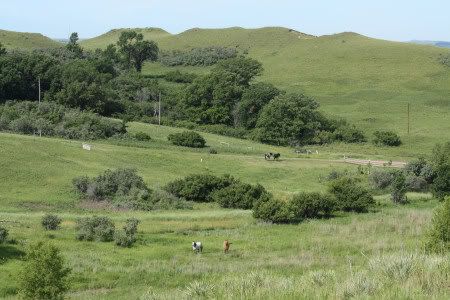
The Setting/View:


Horses grazing in the valley.


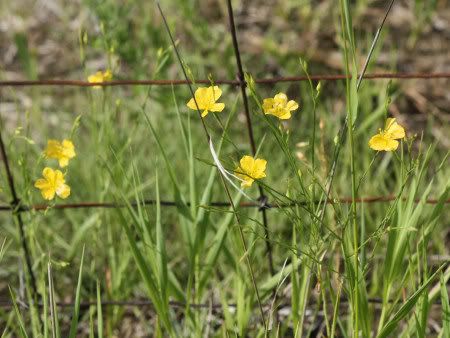
Groved flax blossoms below his feet and dotting the landscape.


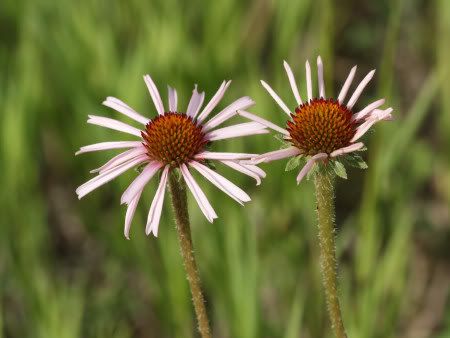
New coneflowers bursting forth.


Lark Sparrow Links:

cornell
"With unusual courtship displays as well as plumage, it is like no other sparrow and is the sole member of its genus. "

"Song a melodius jumble of clear notes and trills, interspersed with harsh buzzes and churrs."

enature

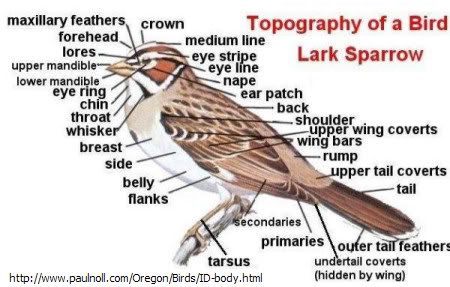
Oregon Birds
Topography of Lark Sparrow
Nice diagram.


And more.
GOOD informative interesting bird info/diagrams here.

Red-tailed Hawk

Photo Drive.
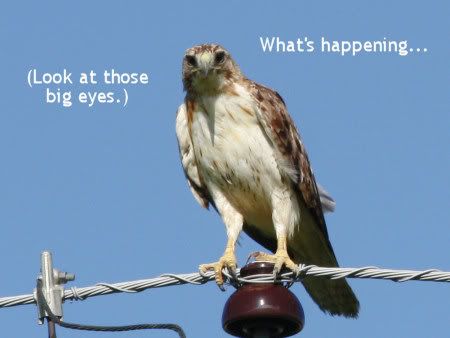
Outsmarting the hawk.
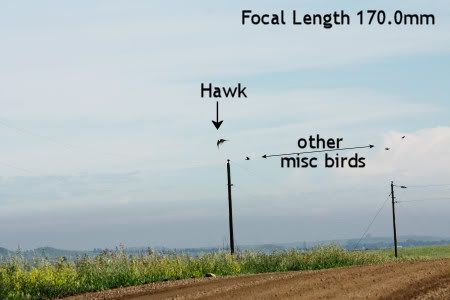
The hawks sighted were high atop the powerline poles along the gravel road.
They would stay there IF you just drove by as usual.
If we would stop within photographing distance (70-300mm tele), they would fly away.
You could not stop at a distance and slowly approach on foot either. Forget about it.


The second hawk sighted was more tolerant than the other one and stayed longer. If we stopped, he would fly down about 5 poles and land atop one again. He did this several times so we got several tries.

So...

Our strategy was to drive by about 15-20 mph, and then stop right in front of the pole, with camera ready and focusing.

This strategy of the unexpected seemed to catch the hawk by surprise for a few seconds and I'd get maybe one or two shots in at full stop before he flew off.

(I tried fiddling with different settings on my camera, but that didn't really help much. Probably continuous shooting helped a little. The continuous focusing setting didn't seem to focus well in this situation.)

Success!
I ended up getting the best hawk shots ever, so far.
It was a fun challenge.


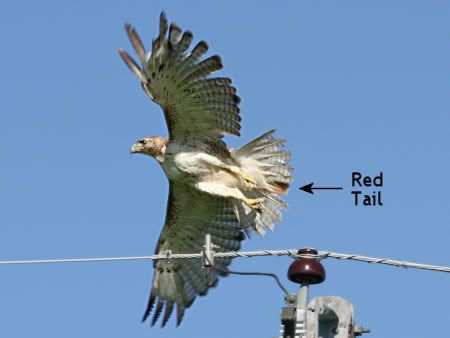
Red Tail:


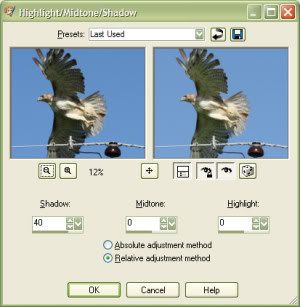
I used Highlights/Midtones/Shadows Photo Adjustment in Paint Shop Pro 9 to lift shadows and bring out more detail.


Red-tailed Hawk Links:

enature

cornell
Red-tailed Hawk (Buteo jamaicensis)
"This is probably the most common hawk in North America. If you’ve got sharp eyes you’ll see several individuals on almost any long car ride, anywhere."

Color Pattern
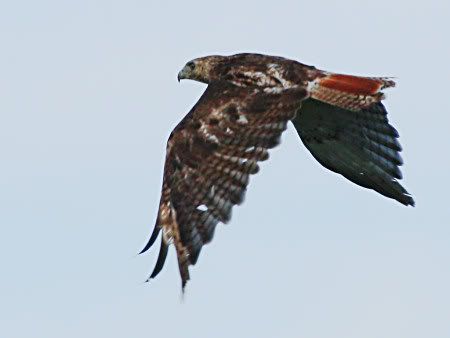
"Most Red-tailed Hawks are rich brown above and pale below, with a streaked belly and, on the wing underside, a dark bar between shoulder and wrist. The
tail is usually pale below and cinnamon-red above, though in young birds it’s brown and banded. “Dark-phase” birds are all chocolate-brown with a warm red tail. “Rufous-phase” birds are reddish-brown on the chest with a dark belly."

Vision
"Based on the size of their eyes alone, you might guess that birds see extremely well. Their eyes are much larger in proportion to the sizes of their heads than our eyes are.. In fact, some owls and eagles have eyes that are the same size as human eyes, though their heads are much smaller than ours.

Birds' sense of sight is much higher resolution than ours. Hawks, for example, see two to three times as much detail than people do. But most birds do not have the depth perception that we do because of the placement of their eyes. Depth is perceived when each eye provides a slightly different view of the same scene, when there is an overlap in the field of vision. This is known as binocular vision. Birds such as Owls, which have both eyes facing forward, have binocular vision similar to our own, but most nonpredatory birds have eyes whose fields of view do not overlap enough to provide this ability. Instead, their laterally placed eyes give them a wider total view, the better to detect an approaching predator. Scientist believe that to compensate for their lack of binocular vision, some birds bob their heads, thereby viewing the same subject rapidly from different angles. Dippers bob nonstop along mountain streams. Many shorebirds bob rapidly when a predator appears nearby. "

See also: Hearing.
And more.
GOOD informative interesting bird info/diagrams here.

Monday, June 21, 2010

Hawk


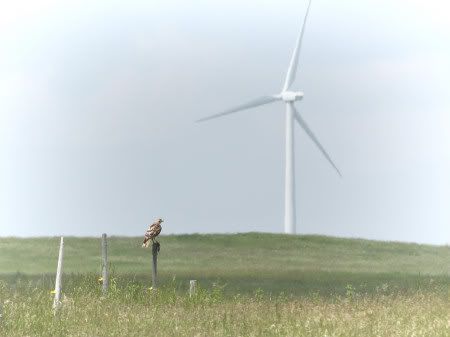
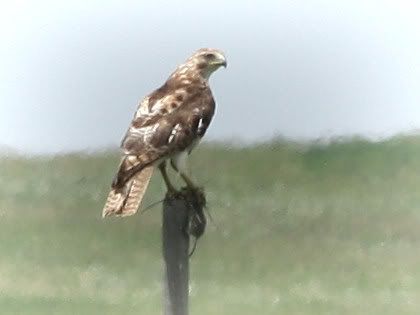
This hawk was bigger than usual, but I'm not sure what it is.
I think it might be a tad over exposed.
I added the border fade post-processing and liked it.
He was far far away, this is a crop of 300mm and then a closer crop.
That is a mouse in his claw.

Sunday, June 20, 2010

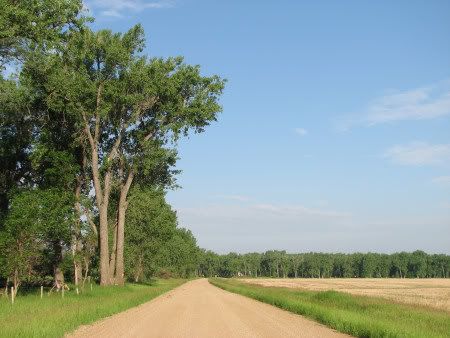
Cottonwood Road

"Cottonwood Road"


Another road/trail pic I like.
Big old cottonwood trees.

Damselfly


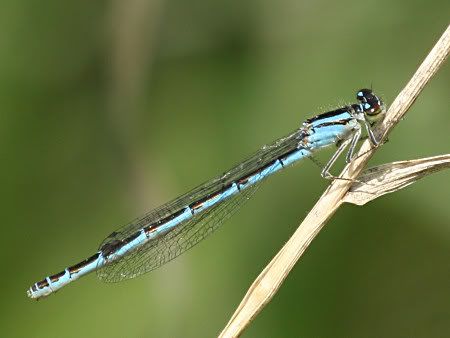
Damselfly.
My companion saw it, I didn't, so I handed him the camera with tele and he took the picture.
Nice one too.

For ID,
I got it drilled down this far:
bugguide
Phylum Arthropoda - Arthropods
Class Insecta - Insects
Order Odonata - Dragonflies and Damselflies
Suborder Zygoptera - Damselflies
Family Coenagrionidae - Narrow-winged Damselflies
Genus Enallagma - American Bluets

Possibilities:
Species carunculatum - Tule Bluet
Species civile - Familiar Bluet
Species clausum - Alkali Bluet
Species exsulans - Stream Bluet
Species praevarum - Arroyo Bluet

All things considered (area, photos, etc.) my guess would be:
Alkali Bluet

npwrc
Dragonflies and Damselflies (Odonata) of the United States
Odonata of North Dakota


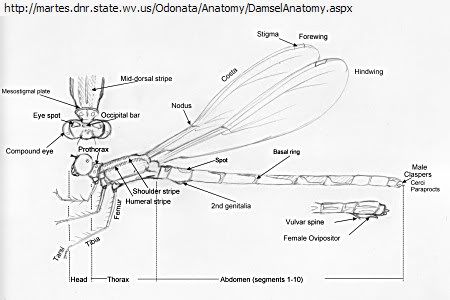
(Dragonflies and Damselflies of West Virginia Site - GOOD diagrams)
Damselfly Anatomy

Dragonfly Anatomy

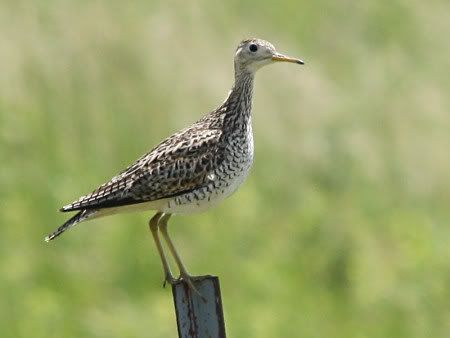
Upland Sandpiper


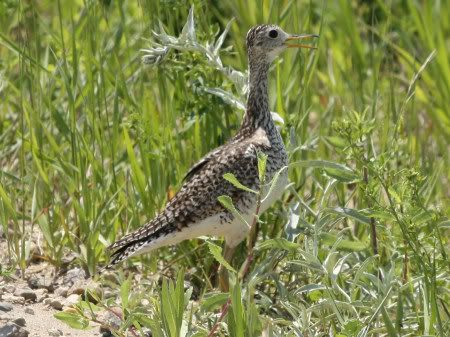
Upland Sandpiper (Bartramia longicauda) formerly known as Upland Plover.

Juvenile? standing along side of gravel road on the prairie.

Mama to the rescue:


I could HEAR her coming before I saw her pop up out of the grass onto the fence post on the other side of the road.
Juvenile ran towards Mama.
That is my guess at what was happening.
The juvenile does not look very young, but the scene and behavior made me think it was probably a juvenile.

enature

cornell
A shorebird of grasslands, not shores, the Upland Sandpiper inhabits native prairie and other open grassy areas in North America.
Juvenile similar to adult, but with pale edges to back feathers.

Wolf-whistler
Sound at Cornell link has a good sample of this bird's wolf-whistle.
I always wondered what kind of bird made that sound! Now I know.

npwrc
Breeding Birds of North Dakota
Family scolopacidae
Upland plover (Bartramia longicauda (Becchstein))