Showing posts with label Zoo. Show all posts

Saturday, October 02, 2010

Zoo5 - Raptors

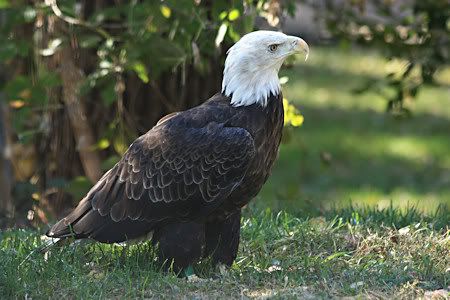
Bald Eagle (Haliaeetus leucocephalus)

cornell
enature

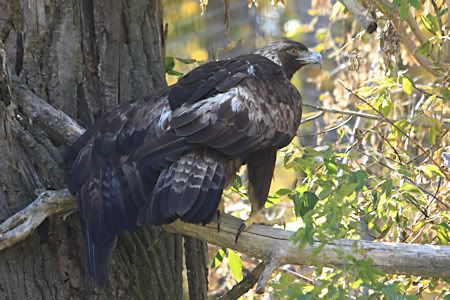
Golden Eagle (Aquila chrysaetos)

cornell
enature

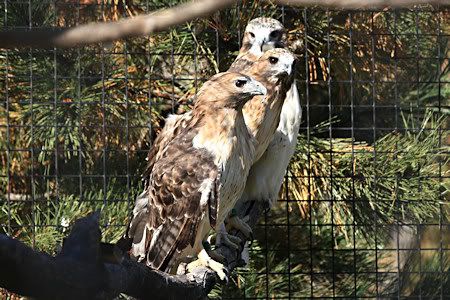
Red-Tailed Hawk (Buteo jamaicensis)
I've posted Red-Tailed Hawk pics before, but not a trio:
"OK everybody, say cheese."


cornell
enature

Hawks, Eagles, and Falcons of North Dakota

Dakota Zoo Facebook
Bald Eagle Pic
"The Dakota Zoo serves as a rehabilitation center for injured and orphaned raptors. These birds are on loan to us from the U.S. Fish and Wildlife Service."

Zoo4 - Snowy Owl


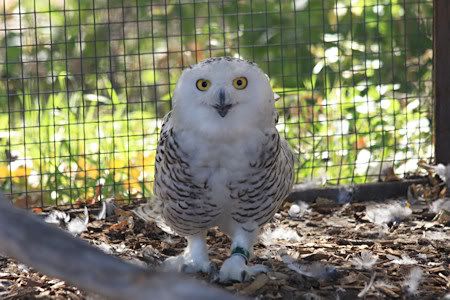
One of my favorites at the zoo, was the Snowy Owl (Bubo scandiacus).

She (I think it's a female) would get a little excited— fluff up the wings/feathers, go around in a circle, and make noise— if I shuffled my feet in the pile of leaves on the trail. So that was quite entertaining. :) I should really capture these moments on video, but just wasn't prepared for that.

enature
Snowy Owl (Nyctea scandiaca)
"Strictly a bird of open country, it is practically never seen in a tree; it sits on the ground, a rooftop, or other exposed resting place."

wiki
Bubo scandiacus (Linnaeus, 1758)
Synonyms:
Strix scandiaca Linnaeus, 1758
Nyctea scandiaca Stephens, 1826
"Until recently, it was regarded as the sole member of a distinct genus, as Nyctea scandiaca, but mtDNA cytochrome b sequence data (Olsen et al. 2002) shows that it is very closely related to the horned owls in the genus Bubo."

Sign at Zoo said:
"...recently found to be very closely related to the Great Horned Owl through DNA analysis."
"adult male is nearly solid white, while the females are mottled with black."
"Unlike most other owls, they hunt primarily during the day."

owlpages
"These Owls are highly diurnal, although they may hunt at night as well."

Diurnality
diurnal [active during the day] vs nocturnal [night] vs crepuscular [twilight]

npwrc
"...the snowy is a regular wintering bird in North Dakota and can often be seen perched conspicuously on haystacks, fence posts and stumps."

Owls of North Dakota

Flickr

Zoo3 - Cat Family - Felidae2

More cats.
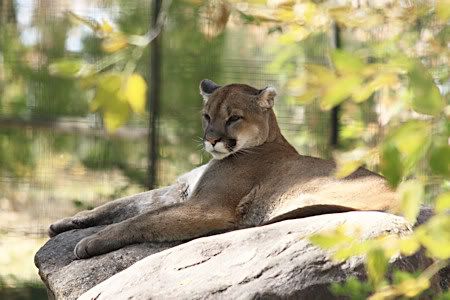
The bobcat and puma photos were my favorites for the more natural setting.

Puma:


enature
NatGeo

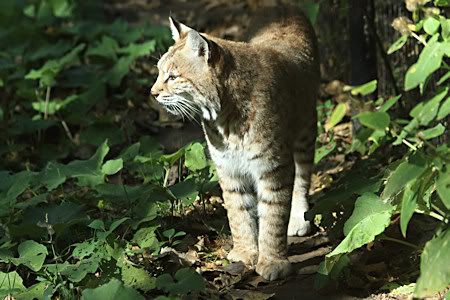
Bobcat (Lynx rufus):


Wiki
enature

There was supposed to be a Canada Lynx (Lynx canadensis)
there too.

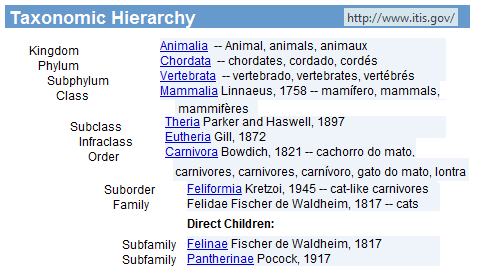
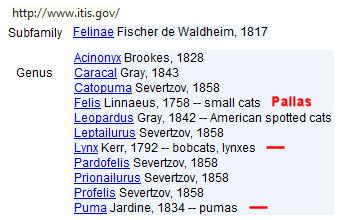
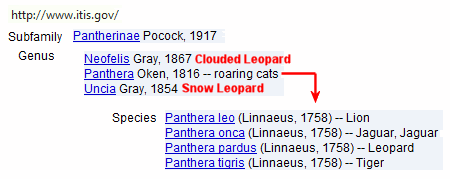
That got me thinking about Bobcat vs Lynx and Cat Family in general. So I studied that taxonomic info for a while.

Taxonomic Info


Pallas, Puma (Mt Lion/Cougar), Bobcat/Lynx


Tiger, Leopard:


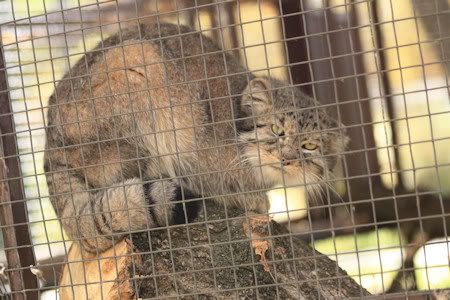
Here's a photo of a pallas (Otocolobus manul)—new arrival at the zoo, evidently:

wiki

Small Mammal Checklist for North Dakota:
npwrc
Family Felidae:
(Felis concolor) Mountain Lion
(Felis lynx) Lynx
(Felis rufus) Bobcat

Zoo2 - Cat Family - Felidae

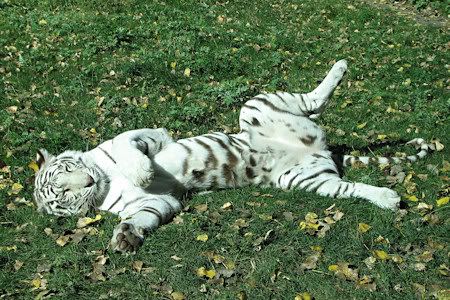
The star of the show was a White Bengal Tiger (Panthera tigris) because she(?) came right up to the viewing window and gave me several poses for my photo shoot.


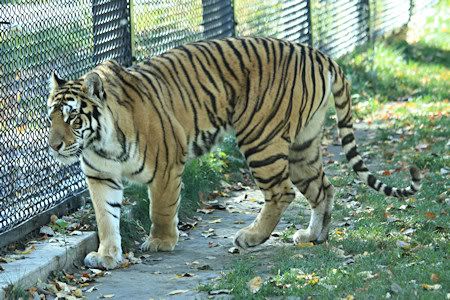
Bengal Tiger (Panthera tigris):


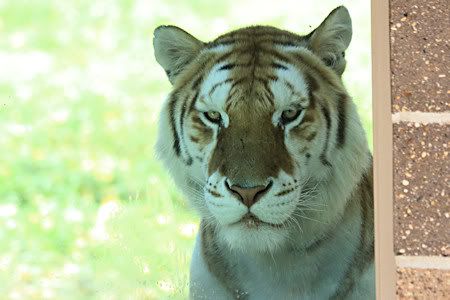
Golden Tabby Tiger (Panthera tigris):

Seemed kind of out of it. Just stood there in front of the picture window and starred. I could put my face right up to the glass and she/he wouldn't move. Well, I certainly got up close and saw detail that way. ;)
Zoo sign said:
"There are no known golden tabby tigers currently in the wild."
"Sometimes called the 'strawberry tiger,' due to the coloration, this is a color variation of the Bengal tiger, and not a separate species."
"Records indicate that there are less than 30 golden tabby tigers in the world."

All three Bengals are on loan from T.I.G.E.R.S..

Bengal Tiger NatGeo
Bengal Tiger Wiki
White Tiger Wiki
"This coloration is caused by a recessive gene."

Zoo1- Photo Shoot

This is my first photo shoot at a zoo.
I took both of my cameras. The Canon S3 point and shoot (for wide angle and great DOF or sharp thruout) and the XSi Canon with telephoto lens for close ups and blurred backgrounds. It was a little challenging blurring out the fencing. Sometimes my cameras just would not focus correctly. I changed to Manual Focus setting. And then sometimes the situation just wasn't right either. If the subject was too close to the fence I couldn't blur it out.

Another thing to be mindful of are any subjects with white coloring had the tendency to get overexposed and I'd lose detail in that area (like the bald eagle). So maybe shoot a little underexposed/dark in those situations.

On to the photos - part 1:

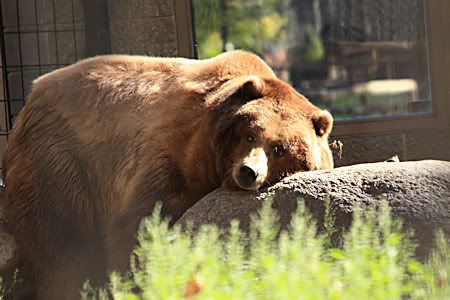
Alaskan Brown Bear (Ursus arctos) or Grizzly Bear (Ursus arctos horribilus):

The bear looked kinda depressed or lonely or something, standing there with his head on the rock.
Brown Bear Links: wiki and NatGeo
Grizzly Links: wiki and NatGeo

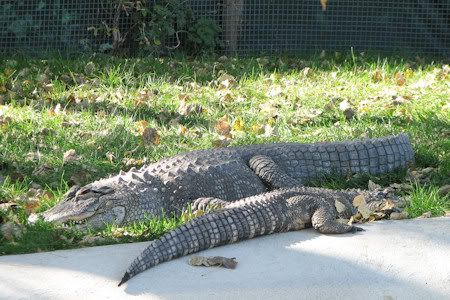
American Alligator (Alligator mississippiensis):

Wiki

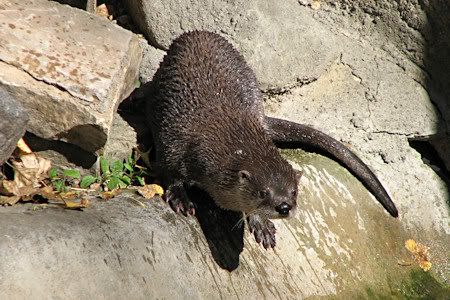
River Otter (Lontra candensis):

Supposed to have these in North Dakota. Didn't know that.
On a npwrc checklist
Family Mustelidae - in with the weasel, ferret, badger, mink, skunk.
Wiki on Otter

Dakota Zoo Map
Dakota Zoo Facebook